Choosing Beginner-Friendly Sewing Projects That Actually Sell
I started my small business with a few simple sewing projects for selling, and honestly, it changed how I think about handmade goods. After a few failed attempts at complicated patterns, I realized that the best items to sell are the ones you can make in under two hours with basic materials. Tote bags, for example, sell almost every time I set up at a market. They require less than a yard of fabric, a straight stitch, and maybe a pocket if you want to add value. Pillow covers are another winner. People love switching out their decor seasonally, and a basic envelope closure pillow cover takes me about 30 minutes to cut and sew.
What helped me most was testing three or four simple designs before committing to bulk production. I made ten tote bags in different fabrics and brought them to a local craft fair. The ones with a bright floral print sold first, followed by solid linen in neutral tones. That taught me to pay attention to what customers actually pick up, not just what I enjoy sewing.
Best Materials for Handmade Items That Hold Up Over Time
When you are making items to sell, fabric choice matters more than you might think. I learned the hard way that cheap cotton from a discount store pills after two washes, and customers notice. For tote bags, I now use a 10-ounce cotton canvas or a heavy twill. Both hold their shape and feel sturdy. For pillow covers, a quality linen blend or a medium weight cotton works well and looks crisp.
Thread is another detail I underestimated early on. A good quality all-purpose polyester thread (like Gutermann or Coats & Clark) reduces breakage and makes seams look professional. Avoid bargain bin thread because it snaps when you pull the fabric taut, and that frustrates you as the maker. I also recommend using a walking foot on your machine for thick layers. It prevents shifting and gives a clean stitch. Here are a few materials I keep stocked for popular projects:
- Heavy canvas (10 oz or more) for tote bags and market bags
- Linen blend or medium weight cotton for pillow covers
- Cotton webbing (1 inch wide) for bag straps
- Magnetic snaps or Velcro for closures on pouches
- Fusible interfacing to add structure to wallets and clutches
Simple DIY Crafts That Sell Well at Local Markets
Through trial and error, I discovered that simple accessories outperform complicated garments almost every time. People do not usually buy hand sewn dresses from a craft stall they are less likely to fit, but they will grab a zippered pouch or a small coin purse without hesitation. My best selling item is a flat cosmetics pouch made from two rectangles of quilting cotton, a zipper, and a little interfacing. It takes me about 20 minutes to make, and I sell them for $12 each. That is a good profit margin when the materials cost under $2.
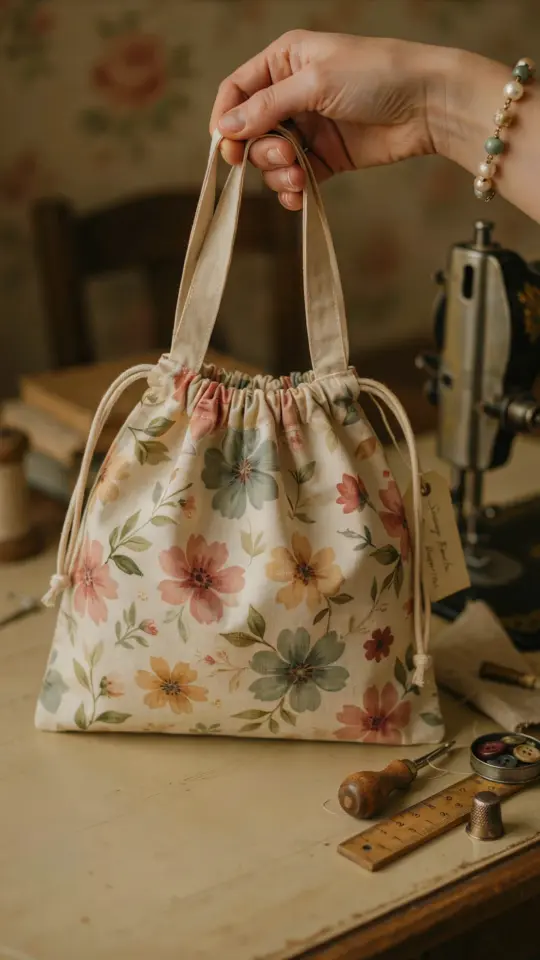
Another craft that I keep in my rotation is the simple drawstring bag. I use them for gift wrapping, lunch bags, or small storage. I make them in sets of three in coordinating fabrics and price the set at $15. They look finished, but the sewing is just a French seam and a casing for the cord. Customers often buy multiple sets for wedding favors or classroom gifts. I also make fabric keychains with a small charm for $5 each, and they are some of my quickest sellers at holiday markets.
One thing I learned is to offer a few variations in color and print. Some people want neutral beige, others want loud polka dots. If I bring only one style, I miss sales. So I now prepare three color families (bright, neutral, and patterned) for each item type.
Pricing Your Handmade Sewing Projects for a Profit
Pricing is the part I struggled with the most. I used to underprice because I felt bad charging more than a store price, but I was not covering my time. After a few months, I started using a simple formula: materials cost multiplied by three, plus your hourly rate. For example, if the fabric, thread, and zipper cost $3.50, then $3.50 x 3 = $10.50. Then add your time. If the pouch takes 20 minutes and you want $15 per hour, that is $5 for time. Total = $15.50. I round up to $16 or $18 depending on the perceived value.
For tote bags, the math is a bit higher because of the fabric yardage. A bag with 0.75 yards of canvas at $8 per yard costs $6 in fabric. Add webbing ($2), thread ($0.50), and a label ($0.50) = $9 material. Times three = $27. Plus 45 minutes of time at $15 per hour = $11.25. Total $38.25. I sell those bags for $35 to $40. That feels fair to both me and the buyer. I do not use the word amazing for my pricing, but I do let customers know the bag is machine washable and reinforced, which justifies the cost.
Marketing Your DIY Crafts Without Feeling Pushy
I am not a natural salesperson, so I had to find a marketing approach that felt genuine. What worked was telling the story behind each item. At markets, I put a small card next to my display that says something like “Handmade in [my city] using upcycled fabric remnants.” People love knowing that the fabric was saved from a landfill. I also use Instagram to post process photos of my sewing machine and the fabric stacks. Not finished products only, but the
#sewingprojects #diycrafts #smallbusiness #handmade #sewingideas
Leave a Comment